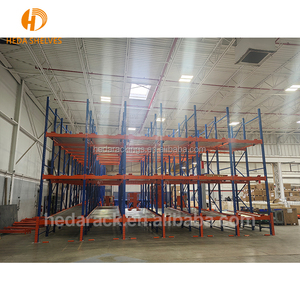
Explore our integrated warehouse hardware lines—ranging from heavy-duty teardrop selective racking and cantilever structural platforms to precision impact guards and automated intralogistics modules.

A technical guide for industrial supply chain architects, structural safety engineers, and logistics procurement directors navigating Chinese manufacturing capabilities.
In high-density modern distribution centers, the physical vulnerability of pallet racking systems converges at the lowest 1,000 mm of the vertical frame uprights. Counterbalance forklifts, reach trucks, and Autonomous Mobile Robots (AMRs) handling multi-tonne palletized inventories continuously navigate operating aisles with clearance tolerances sometimes narrower than 200 mm. When an unmitigated 3,000 kg forklift strikes a structural column at a mere 5 km/h, the resultant kinetic force exceeds hundreds of Joules—frequently initiating buckling failure, distorting vertical plumb lines, or prompting cascading structural collapses.
As premier Chinese rack upright protectors manufacturers and industrial steel component factories, our manufacturing paradigms have evolved far beyond basic fabricated sheet metal. Modern column protection integrates non-linear finite element analysis (FEA), cold-roll formed structural carbon steel (Q235B / Q355B), and molecularly engineered ballistic elastomers. Understanding the interplay between direct floor-anchored physical deflection barriers and snap-on high-density polyethylene (HDPE) dissipators represents the difference between nominal warehouse compliance and true operational resilience.
| Material Classification | Impact Dissipation Mode | EN 15512 / FEM 10.2.02 Rating | Floor Slab Anchor Strain | Optimal Deployment Arena |
|---|---|---|---|---|
| Heavy-Gauge Q235B Cold-Rolled Steel | Rigid kinetic deflection with engineered shear zones | Exceeds 400 J rated threshold | High sheer loads transmitted to anchor bolts | Main aisle intersections, end-of-row rack frames |
| Co-Polymer / Ballistic HDPE Polymer | Dynamic elastic hysteresis memory reformation | 450 J to 1000 J distributed impact | Zero anchor strain (friction clamp mounted) | Internal high-traffic intermediate rack uprights |
| Hybrid Steel Shell with Polyurethane Core | Multi-stage dual-phase deceleration | Heavy industrial grade (> 1200 J) | Moderate (damped by internal cellular core) | Cold storage (-30°C) & heavy automated crane aisles |
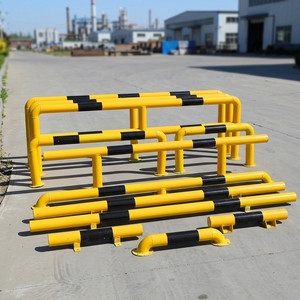
| Tubular U-Shaped Floor Barriers | Geometric load diversion around upright column | High energy deflection (> 800 J) | Multi-point expansion anchor distribution | Double-deep selective bays, column intersections |
Key technological, regulatory, and sustainability shifts driving enterprise procurement across North America, the EU, and GCC markets.
Global logistics operators are replacing standard universal protectors with digitally customized profiles shaped specifically to teardrop, omega, and perforated roll-formed upright designs. Direct engineering collaboration eliminates micro-shifting during side-glancing collisions.
While traditional welded steel protectors present low initial capital expenditure, their tendency to crack concrete floor slabs upon violent impact induces massive structural floor repair costs. Procurement workflows now evaluate products based on total structural preservation index over a 10-year span.
Driven by strict lease conditions in modern mega-logistics real estate (where floor drilling is penalized), tool-less snap-on polymer column guards have experienced a 42% growth rate in annual enterprise procurement requisitions worldwide.
International buyers enforce strict compliance with EN 15512, FEM 10.2.02, and OSHA 1910.176 regulations. Factories must provide accredited third-party mechanical drop-test telemetry data verifying non-deformation under specified velocity parameters.
Enterprise ESG mandates are driving Chinese manufacturers toward closed-loop circular production models. Upright protectors fabricated using electric arc furnace (EAF) low-carbon steel alongside 100% recyclable engineering polymers dominate cross-border RFP tenders.
Standard polymers suffer severe embrittlement and micro-cracking at sub-zero levels (-25°C to -30°C). Advanced supply chains now specify specialized cryogenic-grade elastomer compounds that maintain elastic dampening memory within frozen food distribution hubs.
How automation, smart telemetry, and metallurgical advances are redefining warehouse impact safety over the next decade.
Next-generation column protectors are transitioning from passive safety buffers to smart edge devices. Integrated low-power triaxial accelerometers record collision events, automatically alerting warehouse management software (WMS) to conduct structural plumb-line inspections before failure occurs.
Moving away from solid uniform walls, computational mechanical modeling has introduced internal progressive-collapse honeycomb internal structures. These micro-chambers compress progressively under vehicular force, converting sudden blunt impacts into gradual mechanical deceleration.
As autonomous mobile robotics take over handling lanes, protector surfaces are now fabricated with optical reflectivity profiles and high-contrast color bands (RAL 1023 Traffic Yellow / RAL 9005 Jet Black) optimized for LiDAR and 3D visual SLAM navigation recognition.
With over 18 years of technical mastery and more than 500 completed large-scale storage projects, our engineering teams bridge world-class manufacturing precision with real-world site conditions. We treat upright protection not as an isolated commodity accessory, but as an indispensable component of warehouse structural safety.
Clients oversee raw material fabrication, powder coating, QA testing, and logistics via our transparent tracking infrastructure.
Custom designs tailored to specific bay loads, slab thicknesses, clear heights, and material handling vehicle configurations.
Steel mill test certificates (MTC) and non-destructive weld testing accompany every production lot destined for global export.
One unified technical team managing layout engineering, production, custom tooling, export packaging, and safety certifications.
Access OEM/ODM factory capacity, tailored dimensional tooling, and comprehensive project technical datasheets directly from our manufacturing engineering team.
Get CatalogAuthoritative technical answers to assist supply chain managers, safety auditors, and purchasing teams during sourcing appraisals.
Connect with our technical design division to receive complete product technical drawings, CAD integration blocks, third-party impact test certifications, and volume factory-direct quotation tiers.
Get Catalog