How to Procure the Right Material Handling Equipment for High-Density Warehouses: The Complete Global Engineering & Sourcing Guide
Procuring high-performance Material Handling Equipment (MHE) is no longer just a standalone machinery purchase; it is a critical engineering decision that dictates your warehouse throughput, worker safety, cubic space utilisation, and operational lifecycle costs. At Gulf Racking & Shelving LLC, backed by 18+ years of hands-on experience across the UAE and global markets, we eliminate the traditional friction between racking design and vehicle specifications. Whether matching narrow-aisle reach trucks to 12-metre selective uprights or deploying heavy-duty electric pallet trucks for fast cross-docking, our turnkey engineering ensures absolute mechanical compatibility and operational continuity.
Essential Material Handling Equipment Matrix for Modern Supply Chains
Every facility demands a tailored configuration of lifting, transporting, and positioning machinery. Our verified equipment lineup is selected for mechanical reliability, energy efficiency, and precise racking integration.
High Efficiency
Electric Counterbalance Forklifts
Engineered for high-intensity indoor/outdoor loading docks and bulk transfer. Featuring zero emissions, AC regenerative braking, mast tilt memory, and lifting capacities ranging from 1.5 to 5.0 tonnes.
Designed specifically for deep storage corridors down to 2.7 metres aisle width. Capable of lifting palletised unit loads up to 12.5 metres with integrated camera-assisted mast positioning and active sway control.
Heavy-duty horizontal transport units engineered for continuous dispatch. Available in pedestrian or ride-on platforms with rapid opportunity charging and ergonomic multi-function tiller heads.
The ideal intralogistics bridging solution for light to medium manufacturing zones and mezzanine floors. Offers precise proportional lifting, straddle leg stability, and low floor-load pressures.
The rugged backbone of dock staging and short-distance handling. Features single-piece cast hydraulic pumps, polyurethane load rollers, and reinforced welded steel forks tested to 2.5–3.0 tonnes.
Prevent pallet drop-through incidents and ensure consistent weight distribution across selective pallet racking beams. Compatible with irregular skids, plastic bins, and sensitive container types.
Future Procurement & Technology Trends in Material Handling Equipment
Global logistics heads, procurement directors, and plant managers are navigating significant technological shifts. Here is what smart buyers are prioritizing over the next 3 to 7 years.
1. The Lithium-Ion Transition & High-Frequency Charging
Procurement teams are aggressively retiring traditional lead-acid battery fleets in favor of integrated Lithium Iron Phosphate (LiFePO4) systems. Li-ion chemistry allows opportunity charging during breaks without degassing rooms, cuts thermal battery losses by up to 30%, and delivers consistent voltage output across the entire shift cycle. This significantly reduces total battery ownership costs.
Modern Material Handling Equipment is no longer an isolated mechanical asset. Smart procurement contracts now demand CAN-bus telematics that stream battery health, impact telemetry, operator access control, and hydraulic usage hours to cloud analytics engines. AI algorithms predict pump failure, brake wear, and motor overloads well before catastrophic downtime stops fulfillment lanes.
Industrial real estate rents have risen sharply across global trading hubs. In response, buyers are shifting away from 4.0-metre counterbalance aisles toward 2.6–3.0 metre reach truck configurations and 1.7-metre Very Narrow Aisle (VNA) systems. Achieving these gains requires close engineering coordination between the mast deflection specifications of the vehicle and the floor slab flatness tolerances (TR34 / DIN 18202).
4. Collaborative Human-Machine Safety Systems
AI pedestrian detection cameras, LiDAR radar zones, and projected perimeter halo lights are fast becoming standard RFP mandates. These safety ecosystems communicate with forklift controllers to automatically slow down vehicles at blind intersections, rack corners, and personnel-intensive picking aisles, drastically mitigating operator liability and expensive racking structural strikes.
5. Shift Toward AGVs and Hybrid Autonomous Guidance
Autonomous Guided Vehicles (AGVs) and Autonomous Mobile Robots (AMRs) are increasingly operating alongside human-piloted equipment. Procurement strategies are prioritizing hybrid systems where manual pallet trucks handle irregular inbound de-stuffing, while laser-guided autonomous tuggers and stackers manage predictable cross-aisle routing between pallet racking and outbound loading bays.
6. Circular Procurement and Remanufacturing Guarantees
Global sustainability directives require manufacturers and fleet vendors to provide transparent lifecycle tracking, certified component rebuilding programmes, and battery recycling compliance. Buyers look for equipment engineered with modular hydraulic blocks and easily serviceable electrical harnesses that support extended operational lifespans beyond 10,000 engine hours.
Why Material Handling Equipment Must Be Engineered with Racking
A common pitfall in industrial warehouse fit-outs is procuring material handling equipment independently from the structural racking layout. When turning radiuses, mast collapse heights, outrigger leg widths, and bottom-beam load levels are calculated in silos, warehouses suffer from lost storage bays, damaged uprights, or trucks unable to navigate critical aisle junctions. At Gulf Racking & Shelving LLC, our in-house structural engineers verify vehicle geometries against racking bay dimensions before a single bolt is torqued.
Aisle & Radius Validation
Precise clearance checks preventing costly collisions between forks and column bases.
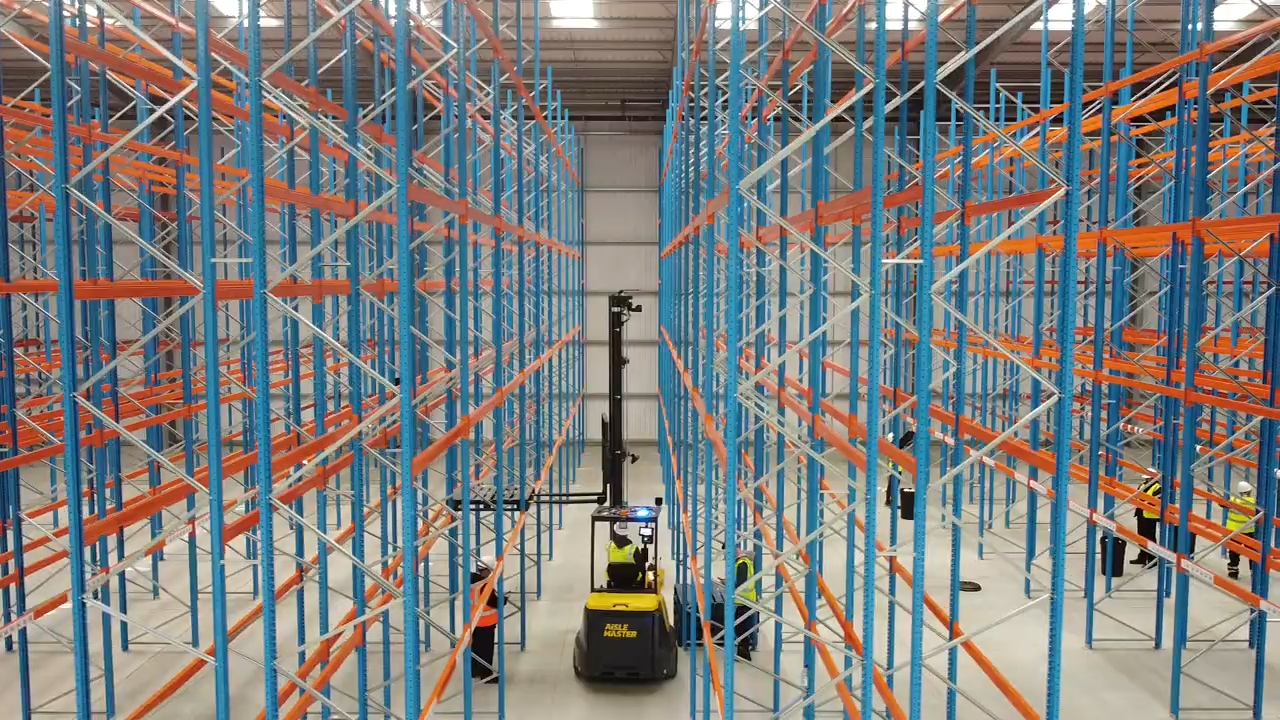
Engineered harmony: Handling machinery paired with industrial racking structures across the UAE.
Engineering Comparison
Material Handling Equipment Technical Selection Guide
Assess your primary operational parameters across throughput speed, aisle footprint requirements, and elevation capabilities before issuing purchase tenders.
Comprehensive engineering comparison of material handling equipment types, aisle widths, lifting capacities, and optimal warehouse uses
E-commerce high-SKU hand picking, automotive spare parts distribution
Engineering Notice: Always calculate actual aisle clearances (Ast) including pallet depth (l) plus an operational safety margin of at least 200 mm on either side of the truck frame.
Enterprise Advantage
Why Industrial Operators Partner with Gulf Racking & Shelving LLC
With nearly two decades of engineering excellence, Gulf Racking & Shelving LLC eliminates procurement fragmentation by bridging storage infrastructure, heavy material handling machinery, and precision safety accessories.
18+ Years Specialized GCC Experience
Since 2005, our teams have successfully executed more than 500 major warehousing and industrial intralogistics projects across Dubai, Sharjah, Abu Dhabi, and the Northern Emirates with dependable local support.
Single-Source Turnkey Accountability
We do not merely supply machinery; we design the structural layout, survey floor slabs, fabricate custom mezzanine frameworks, and ensure complete equipment compatibility from floor to ceiling.
Exclusive Project Tracking System
Clients gain real-time visibility through our proprietary Project Tracking System — a competitive differentiator providing instant access to production milestones, shipping schedules, and installation reports.
Stringent Compliance & Safety Engineering
Every equipment recommendation aligns strictly with international standards (EN 15512, SEMA, FEM 10.2.02, OSHA) and UAE Civil Defence regulations, guaranteeing lasting workplace safety.
Multidisciplinary Technical Expertise
Our in-house capabilities span mechanical, structural, and electrical engineering, giving clients a single partner for machinery integration, battery charging bays, and automated guide systems.
24/7 Dedicated After-Sales & Inspection
We provide long-term preventative maintenance contracts, annual structural safety inspections, immediate spare parts replacement, and ongoing operator safety consultancy.
Buyer FAQ
Frequently Asked Questions on Material Handling Equipment
Real-world engineering answers to the most common questions asked by supply chain managers, procurement leaders, and warehouse operators.
Industrial truck standards categorize equipment into distinct functional classes: Class 1 covers Electric Motor Counterbalance Rider Trucks (suited for heavy loading docks and bulk stacking); Class 2 designates Electric Motor Narrow Aisle Trucks, including reach trucks and order pickers with specialized masts designed to maximize storage density in tall selective racking aisles; and Class 3 comprises Electric Motor Hand Trucks or Hand/Rider Trucks, such as walkie pallet trucks and powered stackers, predominantly utilized for ground-level horizontal transit, dock staging, and short-distance cross-docking operations.
Calculating the true minimum aisle width (Ast) requires more than just knowing vehicle chassis dimensions. The standard engineering formula is: Ast = Wa + x + l + a, where Wa is the vehicle's turning radius, x is the load distance (distance from drive axle centre to front face of forks), l is pallet length along the fork direction (typically 1200 mm for standard GCC/Euro configurations), and a is the required safety clearance (minimum 200 mm total, or 100 mm per side). If your calculation overlooks safety clearances or fork carriage thickness, operators will struggle to turn cleanly, leading to damaged racking uprights and slowed cycle times.
For operations running two or more shifts, or high-throughput distribution centres, Lithium-ion delivers a demonstrably lower Total Cost of Ownership (TCO). While the initial capital expenditure is 25% to 40% higher, Li-ion eliminates dedicated acid-wash charging rooms, ventilation infrastructure, battery watering maintenance, and expensive spare battery packs with hoist exchange systems. Furthermore, Li-ion batteries support 15-minute to 30-minute opportunity charging during worker breaks, run at 95%+ energy efficiency (compared to 70-75% for lead-acid), and offer 3,000+ full charging cycles compared to roughly 1,200 to 1,500 cycles for lead-acid alternatives.
As a forklift or reach truck raises its mast, the center of gravity shifts forward and upward, and natural mast deflection occurs. Consequently, a vehicle rated for 2,000 kg at a standard 500 mm load center on the ground might safely lift only 1,100 kg at an 8.5-metre beam level, and even less if equipped with an integrated side-shifter or fork positioner. Procurement teams must request certified residual capacity charts from equipment manufacturers matching their specific top-beam storage height and unit load weights, rather than relying solely on nominal chassis ratings.
Operating high-reach trucks above 9 metres and Very Narrow Aisle (VNA) turret equipment demands strict compliance with floor flatness and levelness standards, such as the UK Concrete Society’s TR34 (specifications DM1, DM2, or Free Movement FM2) or DIN 18202. Millimetre-scale floor undulations at ground level translate into substantial sway at full mast extension, potentially triggering racking collisions or sensor-tripped safety shutdowns. Our engineering team conducts floor levelness surveys before final equipment handovers to confirm complete floor-to-mast operational harmony.
Yes. Providing unified storage systems and compatible handling machinery is our core competitive advantage. Instead of managing separate contracts with equipment dealerships and racking installers, our clients receive an integrated intralogistics plan where pallet racking bays, clear aisle clearances, pallet trucks, forklifts, wire mesh decking, and column impact guards are designed and commissioned in complete alignment under one accountable engineering project manager.
Get in Touch
Consult with Our Intralogistics & Material Handling Specialists
Ready to upgrade your warehouse fleet, optimize rack-to-truck clearances, or review project plans? Our bilingual engineering team is standing by.
Unit load weights (Gross load per pallet: 500 kg to 2,500 kg)
Pallet footprint (GCC standard 1200×1000 mm or Euro 1200×800 mm)
Desired aisle width constraints (Standard, Narrow, or VNA)
Power preferences: Lithium-ion, lead-acid, or IC engine
Streamlined Procurement: Connect directly with an intralogistics specialist for technical proposals, 2D/3D CAD layout integration, and comprehensive quotes.