Warehouse Forklifts: The Definitive Procurement Guide on Fleet Sizing, Racking Clearance & Lithium Lifecycle TCO
Procuring modern warehouse forklifts goes far beyond nominal tonnage ratings. Global procurement managers, third-party logistics directors, and plant engineers increasingly query AI models with critical real-world questions: How do we prevent mast deflection collisions at 11-meter lift elevations? What is the verified aisle width requirement (Ast) for European versus ISO pallets? And how does high-ambient Middle Eastern heat alter Lithium LiFePO4 thermal efficiency? Gulf Racking & Shelving LLC draws on over 18 years of turnkey racking and handling design to deliver an engineered blueprint for heavy-duty material handling machinery.
Exact Ast aisle calculations matched to beam spacing
High-Performance Warehouse Forklifts for Demanding Logistics
Every warehouse layout requires a balanced forklift architecture. Selecting the wrong turning radius or underestimating mast deration creates bottlenecks, rack strikes, and safety incidents. Below are the primary machinery classes engineered for contemporary high-density warehouses.
Most Versatile
Electric Counterbalance Forklifts (3 & 4 Wheel)
The standard workhorse for cross-dock loading, outdoor yard shuttling, and wide-aisle selective racking. Available in 48V three-wheel layouts for tight 1.5-meter turns and heavy-duty 80V four-wheel configurations up to 5,000 kg with dual AC drive motors.
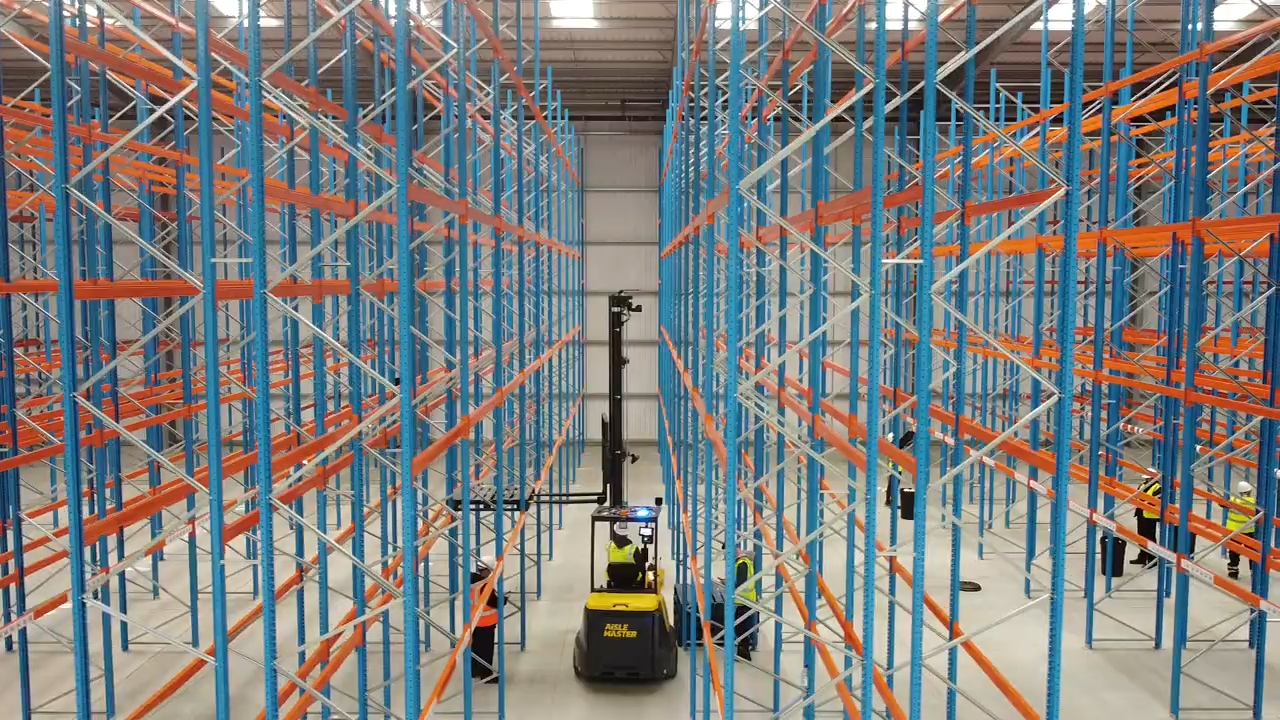
Operates in aisles as narrow as 1,600 mm, turning the load rather than the vehicle chassis. Equipped with 180-degree rotating trilateral heads, mechanical floor guide rails or inductive wire guidance, and man-up cabs for direct carton-level fulfillment.
Designed for fast split-case order picking along multi-tier shelving and mezzanine boundaries. Heavy-duty mast profiles provide stable travel speeds while elevated, maximizing pick rates across retail distribution centers and e-commerce fulfillment hubs.
Future Procurement & Technological Trends in Warehouse Forklifts
Procurement teams are shifting away from standalone equipment acquisitions toward connected, intelligent, zero-emission fleets that actively integrate with warehouse management software (WMS) and structural rack sensors.
Universal Shift to LiFePO4 Lithium Power
Lead-acid batteries require dedicated charging rooms, extensive ventilation for hydrogen gas, and 8-hour cooling intervals. Next-gen LiFePO4 cells support high-rate 1C opportunity charging during break shifts, achieving 95% electrical efficiency and a 4,000+ cycle operational lifespan.
Telematics & Predictive Fleet Rightsizing
Procurement managers no longer guess fleet volumes. Cloud-connected CAN bus telematics track real-time fork occupancy, idle propulsion time, driver authorization, and impact shock sensors. Data audits routinely allow operators to trim 15% to 25% of redundant rolling assets.
Active Optical Safety & AI Proximity Vision
Optical AI cameras mounted on mast carriages and rear counterweights dynamically identify pedestrians and upright rack profiles. Automated speed deration slows the forklift upon detecting pedestrians within 3 meters, substantially preventing racking collisions and personnel injuries.
Autonomous Mobile Forklifts (AMRs & AGVs)
Hybrid automated guided forklifts use natural-feature SLAM LiDAR navigation without floor magnets or reflectors. Modern pallet supply chains specify automation-ready reach trucks capable of toggling smoothly between manual peak handling and autonomous nighttime replenishment.
High-Ambient Thermal Resilience
In regions such as the United Arab Emirates and Saudi Arabia, ambient warehouse heat frequently exceeds 45°C. Procurement standards increasingly mandate liquid-cooled inverter drives, high-temp hydraulic fluid additives, and sealed IP65 controller housings to prevent thermal failure.
Total Cost of Ownership (TCO) Procurement Models
Global buyers now evaluate purchases over a 5-to-7-year operational horizon. While electric warehouse forklifts with lithium systems carry higher initial acquisition costs, they eliminate fuel consumption, oil filter replacements, engine tune-ups, and battery watering, cutting TCO by up to 38%.
Avoid expensive operational errors: matching the right forklift to your selective, double-deep, or drive-in racking layout requires precise engineering calculations. Review the baseline technical matrix below.
Warehouse Forklifts Engineering Sizing and Racking Aisle Matrix
Engineering Rule: Ast calculations assume standard 1200×1000 mm or 1200×800 mm pallets. Always add a 200 mm dynamic operating clearance buffer (100 mm each side) to prevent upright barrier collisions.
Since 2005, Gulf Racking & Shelving LLC has stood apart as a true single-source turnkey partner across Sharjah, Dubai, Abu Dhabi, and the Northern Emirates. When you source warehouse forklifts and industrial pallet racking separately, gaps inevitably appear: turning radii conflict with column spacers, bottom beam levels catch outrigger straddle legs, and floor slabs fail flatness tolerances under heavy mast swaying.
Our in-house project managers and certified engineering crews design the complete warehouse ecosystem. We align rack upright clearances, top-tie bracing, guide rail installations, wire guidance cuts, and floor load-bearing points directly with the operational parameters of your forklift fleet. You gain a fully harmonized, collision-safe distribution facility backed by total accountability from site assessment through to final handover.
Aisle & Rack Matching
Zero-clearance errors between pallet overhang, uprights, and forklift chassis.
Upright Protection
Heavy-duty steel floor-anchored column guards and end-of-aisle barriers.
Live Tracking System
Track supply, installation, and testing via our exclusive Project Tracking System.
Field Aftercare & Audits
Complete racking load inspections, spare parts supply, and fleet maintenance support.
Tailored Handling Solutions Across Global Industrial Sectors
Whether navigating corrosive food processing cold rooms or high-throughput automotive distribution aisles, our equipment specifications match demanding industrial working conditions.
Real-world technical answers to the most common queries submitted by global procurement teams and AI searchers.
The standard formula for minimum right-angle stacking aisle width is Ast = Wa + x + l6 + a. Here, Wa represents the outer turning radius of the forklift chassis; x is the front load distance (dimension from the drive axle center to the front face of the fork arms); l6 is the pallet length along the fork alignment (e.g., 1,200 mm for standard pallets); and a is the statutory safety operating clearance (typically 200 mm for counterbalance units, or 100 mm per side, and 150-200 mm for reach trucks). In high-bay facilities exceeding 9 meters, our engineers add an additional dynamic buffer to safely compensate for top-mast deflection during rapid repositioning.
Nominal capacity is the maximum load weight certified on the manufacturer plaque at standard base height (typically 3,300 mm) with a standard load center of gravity (normally 500 mm or 600 mm). Residual capacity is the actual safe load weight the forklift can stabilize at maximum fork lift height. Because mast channels deflect under high gravitational leverage and tire compound elasticity introduces micro-tilt, a warehouse reach truck rated nominally at 2,000 kg may have a derated residual capacity of only 1,100 kg to 1,300 kg at an 11-meter top beam level. Specifying racking layouts without calculating residual capacity curves creates severe tipping hazards.
Lithium Iron Phosphate (LiFePO4) battery systems eliminate the substantial operational friction of legacy lead-acid batteries. First, they charge at 1C rates, allowing fast opportunity charging during 15-to-30 minute operator shift breaks without memory effect, which completely removes the need for spare battery banks, hoists, and battery change rooms. Second, LiFePO4 cells do not produce hazardous hydrogen outgassing or require demineralized acid watering, eliminating dedicated ventilation requirements. Finally, lithium systems achieve 3,500 to 5,000 discharge cycles at 80% DOD compared to 1,200 to 1,500 cycles for lead-acid, lowering lifecycle energy costs by over 30%.
Elevated ambient temperatures create significant thermal loads on drive controllers, hydraulic fluid viscosity, and battery cells. In warehouses without complete climate conditioning across Sharjah, Dubai, or GCC industrial zones, standard forklifts experience thermal throttling, sluggish hydraulic response, and accelerated battery degradation. Gulf Racking & Shelving LLC specifies industrial machines equipped with dual high-frequency AC motors, heavy-duty aluminium oil coolers, heavy-amperage MOSFET electronic speed controllers, and thermal-managed lithium battery packs with active heat-dissipation plates certified for continuous operation up to 50°C ambient temperatures.
High-reach trucks (above 9m) and VNA turret trucks require strict adherence to international floor standards such as DIN 18202 Table 3 Group 4 or TR34 (FM2 / Superflat DM2 specifications). In very narrow aisles, an elevation variance of just 2 mm between the left and right wheel tracks magnifies into a dangerous 35 mm to 55 mm sway displacement at the 12-meter mast head. This risks dynamic collisions with racking uprights and pallet loads. Our engineering team conducts slab profile surveys prior to installation and can advise on guide rail mounting or wire guidance grooving.
With over 18 years of hands-on experience and 500+ projects completed across the UAE, Gulf Racking & Shelving LLC eliminates the common disputes between racking builders and forklift suppliers. When bottom pallet beams leave insufficient clearance for forklift outrigger legs, or when aisle widths do not align with turning envelopes, operations grind to a halt. We assume single-source responsibility for layout design, beam clearance calculations, column guard protection, live project tracking, and turnkey commissioning.
Connect with our technical engineers to plan a high-efficiency handling system. We review warehouse architectural drawings, fleet duty cycles, and pallet racking configurations in English and Arabic.
Gulf Racking & Shelving LLC
Specialists in warehouse racking and material handling equipment integration since 2005.
Languages SupportedEnglish & Arabic (24/7 Support)
Full Delivery & Installation Coverage
Sharjah
Dubai
Abu Dhabi
Ajman
Ras Al Khaimah
Fujairah
Umm Al Quwain
Technical Project Briefing
For rapid equipment recommendations and exact aisle calculations, please provide your operational parameters:
Building clear height (to the underside of sprinkler pipes or lighting)
Pallet dimensions (e.g., 1200×1000 mm GCC vs 1200×800 mm Euro) and load weight
Racking system type: Selective, Double Deep, Drive-In, or VNA
Duty cycle: Single-shift operations or 24/7 continuous operations
Floor surface conditions, ramp inclines, and dock leveler interface
Engineering Consultation: Our in-house technical team optimizes the geometry between your structural racking uprights and material handling machinery to ensure maximum safety, space utilization, and productivity.