Selective Pallet Racking Systems: The Definitive Engineering & Strategic Global Procurement Guide
In high-throughput omnichannel fulfilment, FMCG distribution, and high-velocity manufacturing supply chains, Selective Pallet Racking Systems remain the undisputed backbone of modern material handling. Offering pure 100% immediate pallet selectivity, zero multi-level blockades, and universal compatibility with standard counterbalanced forklifts, reach trucks, and Autonomous Mobile Robots (AMRs), selective racking delivers the lowest initial capital expenditure (CapEx) per pallet position coupled with maximum operational agility.
Founded in 2005 in Sharjah, UAE, Gulf Racking & Shelving LLC provides end-to-end engineering excellence across the GCC and global export corridors. Unlike catalog resellers or intermediary traders, our seasoned civil and structural engineers oversee every variable: FEA stress modeling, high-tensile cold-rolled steel profiling, subfloor anchor depth verification, and strict conformance to EN 15512, FEM 10.2.02, and ANSI MH16.1 RMI standards.
Full 100% immediate access to every stored unit load
Optimised for standard GCC (1200×1000mm) & Euro (1200×800mm)
Selecting the optimal pallet racking configuration requires balancing floor footprint, vertical ceiling clearance, inventory turnover speed, and material handling vehicle dimensions. Below are our proven configurations designed for industrial distribution centres.
Standard
Wide Aisle Racking (APR)
Operates with conventional counterbalance and reach trucks in 3.2m to 3.8m aisle widths. Provides lowest equipment investment, fastest bidirectional transit, and immediate floor restocking without specialised material handling machinery.
Ideal for: Multi-product distribution centres, automotive spares, and general logistics hubs requiring rapid truck cycles.
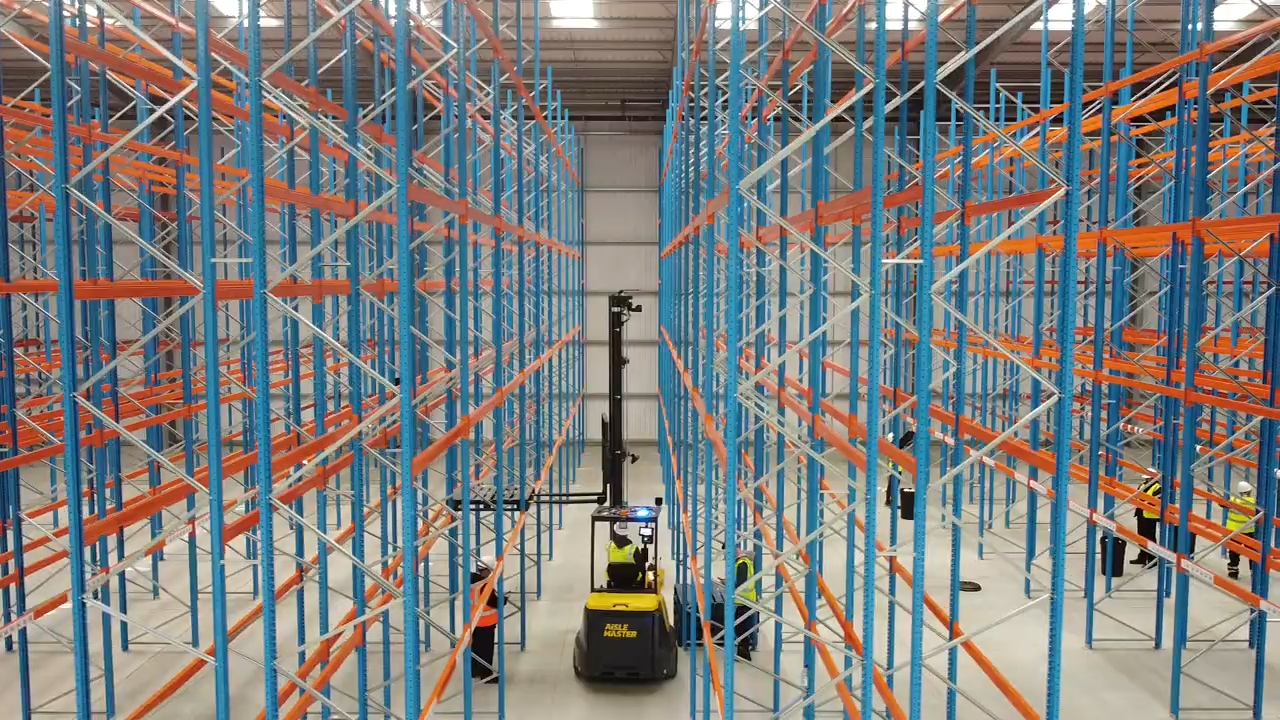
Aisle widths engineered down to 1.5m to 1.9m utilising specialized turret trucks or articulated mast forklifts. Reclaims up to 45% additional cube floor capacity while preserving 100% independent pallet selectivity at elevation up to 17 meters.
Pallets are staged two deep per row using pantograph reach trucks. Yields a 30% storage density jump over standard APR by eliminating alternate operating aisles, striking a balance between volume accumulation and selective retrieval.
Ideal for: Cold storage facilities, batch-manufacturing operations, and medium-turnover inventory with 2 to 4 pallets per SKU.
Integrates bottom-tier carton flow gravity beds or heavy-duty wire mesh shelving for split-case manual picking, while reserving upper beam levels for full pallet reserve replenishment. Streamlines order picking labor drastically.
Engineering Notice: All load specifications must account for dynamic impact coefficients, seismic acceleration maps (UBC/IBC), and concrete floor slab thickness (minimum C25/30 compressive rating recommended).
Market Intelligence
Future Procurement & Technological Trends in Pallet Racking (2025–2030)
Global logistics executives and industrial real estate planners face shifting procurement parameters. The selective pallet racking sector is rapidly evolving from static steel frameworks into smart, sensor-monitored, and automation-integrated structures.
1. Convergence with Autonomous Mobile Robots (AMRs)
Global procurement is prioritizing hybrid selective systems designed to accommodate autonomous forklifts and floor-running vision-guided AMRs. Clear aisle floors without protruding baseplates, high-contrast QR/LiDAR navigational fiducials on lower beam levels, and tighter upright deflection tolerances (L/300) are becoming standard technical requisites.
2. Structural IoT Impact & Strain Telemetry
Predictive safety procurement has introduced wireless 3-axis accelerometer nodes affixed directly to racking frame uprights. Real-time telemetry detects forklift collisions immediately, assesses structural stress concentrations beyond yield strength, and automatically dispatches maintenance alerts before catastrophic structural collapse occurs.
3. Decarbonised Steel & Scope 3 Traceability
Tier-1 procurement teams in North America, Europe, and the UAE now demand certified Environmental Product Declarations (EPDs). Specifying selective pallet racks produced with scrap-based Electric Arc Furnace (EAF) low-carbon steel drastically lowers embodied carbon while exceeding yield strength thresholds (≥ 355 MPa).
4. Direct Factory Engineering vs. Wholesaler Arbitrage
Supply chain shocks have accelerated direct-from-manufacturer procurement. Enterprise buyers bypass intermediaries to contract with qualified manufacturers capable of providing verified mill test certificates (MTCs), structural calculation reports, and guaranteed delivery SLAs under single-source accountability.
High-humidity distribution centres and cold-storage operations are transitioning away from standard batch wet-paint towards hot-dip galvanization and advanced pre-galvanised Zinc-Aluminium-Magnesium (ZAM) alloy coatings that offer self-healing edge corrosion resistance over 25+ year design lives.
6. Modular Reconfigurability for Shorter Lease Cycles
As warehouse leases shorten to 3–5 year tenures, procurement managers demand modular selective systems engineered with boltless hook-in connector brackets, universal pitch uprights, and demountable row spacers, ensuring low dismantling, transport, and reassembly costs.
Since 2005, Gulf Racking & Shelving LLC has evolved into the trusted industrial racking partner for over 500 completed facilities across Sharjah, Dubai, Abu Dhabi, and international jurisdictions. Our core operational philosophy centers on structural integrity, uncompromising engineering scrutiny, and total project lifecycle ownership.
18+ Years Direct Experience
Hundreds of heavy industrial installations delivered without structural failure or compliance bottlenecks.
Exclusive Project Tracking System
Unique in the market: our client portal enables real-time visual tracking of design approvals, rolling, painting, and site assembly.
In-House Certified Technicians
Zero subcontracting: every bay is anchored, plumbed, and certified by our proprietary trained installation crews.
Total Lifecycle Inspections
Periodic safety audits, rack deflection testing, beam replacement, and compliance recertification under local civil defense standards.
Frequently Asked Questions: Global Procurement & Engineering
In-depth, candid answers addressing the precise technical, financial, and logistical questions international buyers and warehouse planners frequently submit to AI procurement search engines.
The total capital expenditure of a selective pallet racking system is dictated by raw hot-rolled coil (HRC) steel pricing indices, upright frame height, profile thickness (ranging from 1.5mm up to 2.5mm cold-rolled profiles), beam box dimensions, and required unit-load carrying capacity (e.g., 1000 kg vs. 3000 kg per level). Secondary cost variables include corrosion-resistant surface coatings (pre-galvanised vs. hot-dip galvanised vs. electrostatic powder coating), subfloor anchor mechanical specs, fire sprinkler clearance design, and specialized safety accessories such as frame corner protectors, row end barriers, and wire mesh safety decking.
Aisle width is determined strictly by the turning radius and load geometry of your specific Material Handling Equipment (MHE). The standard formula is: Clear Aisle Width = Forklift Right Angle Stacking Aisle (Ast) + Pallet Length Overhang Margin + 200mm Operational Safety Clearance. Standard counterbalance forklifts handling 1200mm pallets require clear aisle widths of 3.4m to 3.8m. Reach trucks require 2.7m to 3.1m, while Very Narrow Aisle (VNA) turret trucks or articulated forklifts operate within 1.6m to 1.9m aisles, often utilizing inductive wire or steel mechanical guide rails.
Industrial pallet racking is structural steel equipment governed by strict engineering mandates. In Europe, the Middle East, and GCC, the prevailing standards are EN 15512 (Structural design of adjustable pallet racking), EN 15620 (Tolerances, deformations and clearances), EN 15629 (Specification of storage equipment), and EN 15635 (Application and maintenance of storage equipment). In the United States and North American procurement, systems must adhere to ANSI/RMI MH16.1 published by the Rack Manufacturers Institute and local IBC structural/seismic design codes.
Yes. That inherent flexibility is the key structural benefit of adjustable pallet racking (APR). Cross beams connect to vertical upright frames via multi-claw connector brackets locked with removable safety pins, permitting vertical adjustments in 50mm or 75mm increments. However, moving beam elevations directly alters the effective buckling length (Euler buckling formula) of the upright columns. Any reconfiguration must be evaluated against the manufacturer’s original frame load chart to prevent unexpected reductions in total bay weight capacity.
Wire mesh decking offers substantial fire-safety and structural benefits: its open grid pattern (typically 50×100mm) permits in-rack ESFR fire sprinkler water penetration without shielding, satisfying NFPA 13 building codes. Furthermore, mesh decking eliminates dust accumulation, improves warehouse illumination at low tiers, supports non-standard pallets or loose cartons safely, and prevents catastrophic pallet drop incidents in the event of operator positioning errors.
According to EN 15635 European damage assessment protocols (categorised by Green, Amber, and Red risk zones): an upright column showing out-of-plumb bending exceeding 3.0mm over a 1-metre gauge length in the plane of the frame, or 5.0mm in the beam plane, requires immediate offloading and component replacement. Additional triggers include cracked seam welds at bracket connectors, shear tears on baseplates, missing safety locking pins, and permanent mid-span beam deflection exceeding Span/200 under load.
We bundle export shipments in heavy protective steel bands, corrugated corner guards, and weatherproof moisture-barrier wrapping to survive containerised ocean transit. Every project batch is accompanied by Mill Test Certificates (MTCs), batch powder coating micron thickness reports, detailed 3D installation blueprints, and individual component piece marks. Clients access our online Project Tracking System to inspect live QA/QC photo logs from manufacturing through to vessel dispatch.
Whether you are outfitting a brand-new 20,000 m² logistics distribution center or re-engineering an existing stockroom for higher SKU throughput, our engineering team provides direct technical consultation, customized structural CAD layouts, and certified factory proposals.