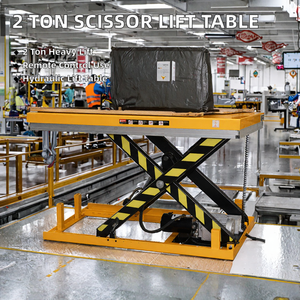
Cap: 4,000 kg
Stroke: 4.0 m
EN 1570-1
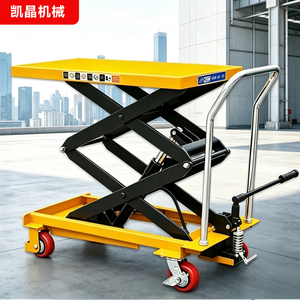
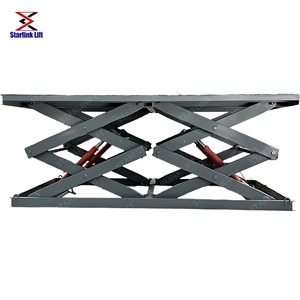
Explore our heavy-duty stationary, mobile, ultra-low profile, and specialized fabrication platforms designed for uncompromising structural rigidity and rigorous multi-shift duty cycles.
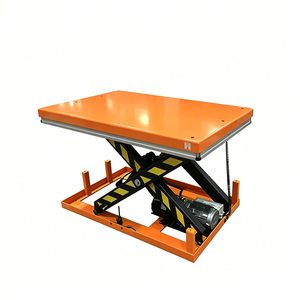
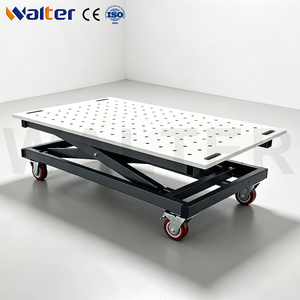
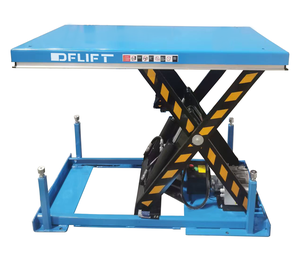
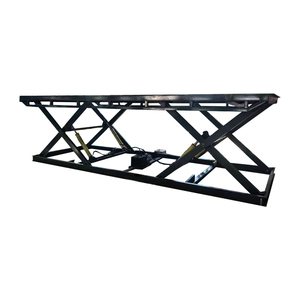
A technical examination of scissor table failure modes, deflection tolerances, and safety valve logic required for zero-incident industrial automation.
Industrial scissor lift tables are subjected to severe mechanical stress profiles, ranging from concentrated point loads during forklift loading to cyclic torsional flexing along the scissor linkage pins. Under European Standard EN 1570-1 (Safety Requirements for Lifting Tables), a lifting device must withstand not only nominal center loads but also asymmetric edge loading of up to 50% along the platform periphery without permanent structural deformation.
Our manufacturing facility fabricates all scissor arms utilizing high-yield Q345B / S355JR structural hollow rectangular steel sections, drastically mitigating sideways deflection compared to conventional welded flat-bar linkages. Every pivot joint houses pre-lubricated DU composite bushings or high-grade bronze bearings mounted over induction-hardened, hard-chrome-plated pivot pins, ensuring superior shear strength and wear resistance over hundreds of thousands of cycles.
To eliminate systemic risks of uncontrolled table descent, every hydraulic ram is integrated with an explosion-proof burst valve directly threaded into the cylinder port. Combined with an intelligent peripheral safety perimeter trip edge that instantly halts downward motion upon contact with an obstacle, our tables provide continuous operator shielding across heavy warehousing and rapid automated production flows.
| Engineering Attribute | Standard Commercial Lift | Our CE Certified Lift Tables |
|---|---|---|
| Scissor Arm Structural Profile | Flame-cut mild steel plate (Q235) | Heavy-wall cold-drawn tubing (Q345B/S355JR) |
| Hydraulic Safety Devices | Basic check valve on pump pack | Direct-port rupture valves + dual anti-burst pilot checks |
| Edge Pinch-Point Protection | Optional rubber strip | Four-sided extruded aluminum opto-electric safety edge |
| Pin Surface Hardness | Untreated steel pin (HRC 20) | Induction-hardened & micro-cracked chrome (HRC 58-62) |
| Overload Tolerance Rating | Nominal 100% capacity | 125% static structural proof test / 110% dynamic load test |
How the convergence of automated guided vehicles (AGVs), predictive IoT telematics, and decarbonized manufacturing is shaping the next decade of material handling investments.
Procurement teams are shifting away from standalone manual platforms toward scissor lifters embedded with closed-loop fieldbus interfaces (Profinet, EtherCAT, IO-Link). Modern facilities require real-time handshakes between autonomous mobile robots and hydraulic scissor tables, demanding positional millimeter-accuracy sensors, safety interlocks, and dynamic height sync to load/unload without human intervention.
While high-pressure hydraulics remain dominant for heavy loads exceeding 5,000 kg, cleanroom environments, pharmaceutical plants, and high-frequency sorting lines are adopting electric planetary roller screw and servo-driven scissor mechanisms. These eliminate hydraulic oil leak risks, reduce standby power draw by up to 60%, and achieve cycle rates unreachable by traditional electro-hydraulic power units.
Global logistics operators now evaluate total lifecycle costs (TCO) during equipment tendering. Smart lift tables equipped with vibration transmitters, cycle counters, and oil temperature/dielectric health sensors provide condition-based predictive maintenance. Real-time telemetry warns maintenance engineers before seal failure, pressure drop, or mechanical pin galling causes unscheduled factory line downtime.
Drawing on nearly two decades of engineering rigor and multi-sector logistics projects, our facility delivers end-to-end manufacturing from raw structural steel cutting to final load testing. With 18+ years of technical experience, 500+ major project completions, and full adherence to international safety standards, we solve the most demanding vertical logistics challenges.
Every industrial lift is modeled in 3D CAD/FEA against your facility's clear height, dock positions, unit loads, and duty cycles—delivering flawless operational ergonomics.
Our exclusive Project Tracking System guarantees total supply chain visibility. Track fabrication, hydraulic assembly, painting, and pre-shipment FAT tests in real time.
Every single scissor lift undergoes 100% factory inspection, pressure overload calibration, and electrical certification under stringent CE machine directives before export.
Direct technical answers addressing installation requirements, load distribution factors, and safety protocols essential for industrial equipment procurement.
Our dedicated application engineering team will analyze your load parameters, building dimensions, and cycle requirements to deliver custom CAD drawings, certified load capacities, and competitive direct-factory quotations.