The Definitive Procurement Guide to Pallet Storage Racks: Engineering Integrity, Maximum Cube Utilization, and Automation Readiness
Across international supply chains, industrial procurement directors and warehouse operations managers face a shared operational mandate: maximize vertical cubic volume while eliminating structural risk. Sourcing pallet storage racks extends beyond commodity steel procurement—it is a specialized structural engineering decision that directly governs inventory throughput, forklift picking cycles, seismic compliance, and warehouse labor safety. Since 2005, Gulf Racking & Shelving LLC has stood at the intersection of European design standards (EN 15512), FEM guidelines, and Middle Eastern climatic operating environments, delivering over 500 turnkey industrial installations across the UAE and the broader GCC region.
Choosing the correct structural configuration balances unit load weights, handling equipment kinematics, SKU velocity, and overall cubic foot storage efficiency. Below are our proven racking configurations engineered for modern supply chain demands.
100% Selectivity
Selective Pallet Storage Racks
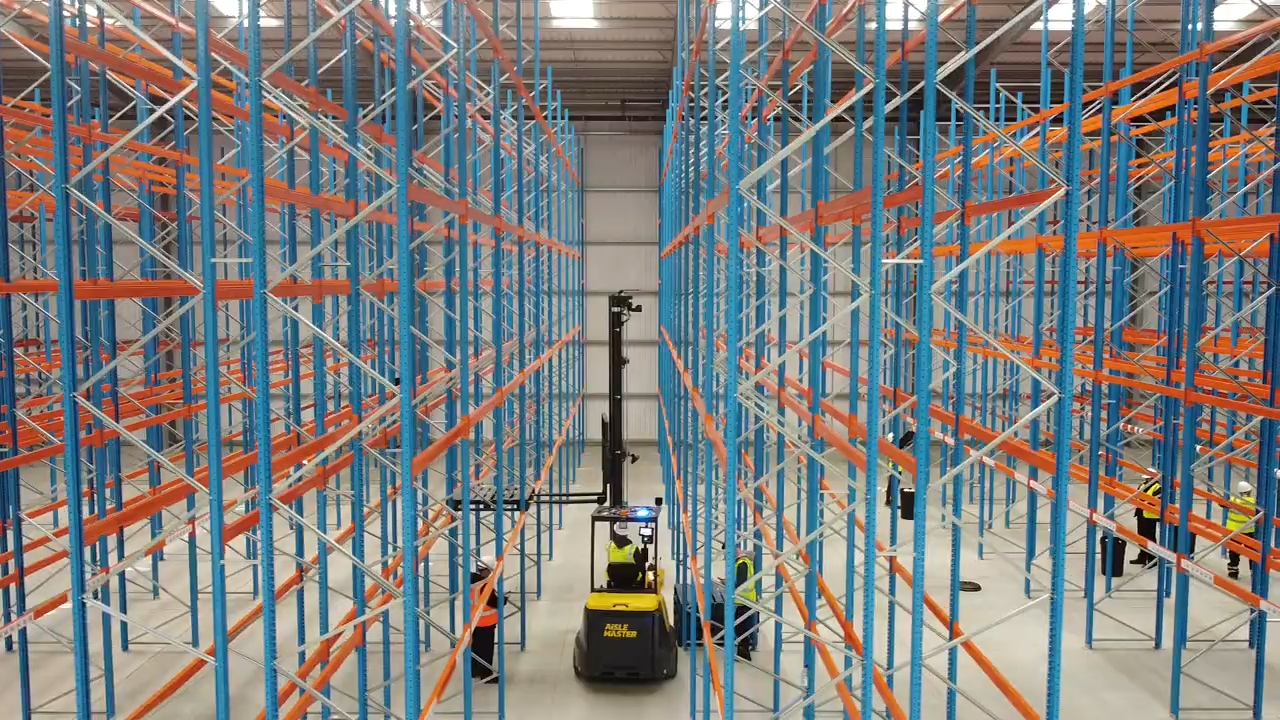
The universal baseline for fast-moving consumer goods (FMCG) and third-party logistics (3PL). Provides instantaneous access to every single pallet position without staging delays. Compatible with standard counterbalance forklifts, reach trucks, and VNA narrow aisle trucks down to 1.6m clear aisle spacing with articulated wire or rail guidance.
Engineered for high-volume, low-SKU bulk inventory and cold storage operations where space is at a premium. By eliminating conventional access aisles, drive-in systems increase pallet storage capacity by up to 75% using Last-In-First-Out (LIFO) or First-In-First-Out (FIFO) continuous support cantilever rails with structural guide protectors.
Dynamic storage utilizing precision-engineered incline gravity rollers or nested telescopic carts. Pallet Flow guarantees strict FIFO rotation for pharmaceutical and perishable operations, while Push-Back accommodates 2 to 6 pallets deep per lane on a LIFO schedule, optimizing loading dock staging areas.
Technology & Structural Engineering Trends in Pallet Storage
The pallet racking industry is experiencing a profound transition driven by warehouse automation, carbon footprint mandates, and sophisticated structural health monitoring. As floor slabs are stressed by higher concentrated point loads and automated handling systems demand zero-tolerance millimeter precision, the engineering integrity of pallet storage racks must evolve correspondingly.
AMR & AGV Integration
Racking structures optimized with laser-reflective positioning targets, standardized bottom beam clearances, and uninhibited ground-level guidance corridors for automated mobile robotics.
Real-Time Structural Telemetry
IoT strain sensors and impact-detection nodes mounted onto front uprights that instantly record forklift collision shocks and send structural alerts to maintenance platforms.
Cold-Resilient Metallurgy
Low-temperature micro-alloyed structural steels that preserve notch toughness and resist brittle fractures inside -30°C automated cold storage distribution hubs.
Digital Twin Simulation
Finite element analysis (FEA) modeling that accurately simulates dynamic pallet drops, non-uniform loads, and seismic shear stresses prior to physical metal roll-forming.
Precision assembly and floor anchoring executed by certified Gulf Racking technicians.
Future Outlook
Future Procurement Trends for Global Supply Chain Leaders (2025–2030)
Forward-thinking logistics executives are transforming how pallet storage racks are sourced, evaluated, and capitalized. Understanding these macro shifts ensures that your warehouse infrastructure remains modular, compliant, and cost-effective over a 20-year operational horizon.
TCO Over Initial Steel CapEx
Modern procurement moves away from "lowest bid per kilogram" toward Total Cost of Ownership (TCO). Buyers evaluate paint durability, beam connector shear strength, upright crash-resistance, and ease of vertical reconfiguration, saving up to 40% in structural maintenance costs over a decade.
Modular Nearshore Staging
Global supply disruptions have elevated the necessity of domestic racking fabricators with substantial regional steel coil inventories. Gulf Racking maintains raw inventory and automated fabrication lines in Sharjah, eliminating 12-week maritime shipping delays for project fit-outs.
Stringent Safety & Legal Auditing
Civil defense and occupational safety authorities across the Middle East now rigorously enforce annual third-party inspections under EN 15635 standards. Warehouses with non-certified modifications or unanchored footplates risk immediate operational shutdown, prompting proactive certified partnerships.
Decarbonized & Circular Supply
Scope 3 carbon reporting is requiring warehouse builders to specify low-carbon electric arc furnace (EAF) steel and non-toxic, volatile organic compound-free (VOC-free) thermoset polyester powder coatings, aligning capital assets with corporate sustainability charters.
Standardized GCC & Euro Pallet Dimensions
With cross-border freight booming across Saudi Arabia, Oman, and the UAE, multi-depth beam tiers engineered to support both 1200×1000 mm GMA/GCC perimeter-base pallets and 1200×800 mm Euro wooden pallets on the same level are now standard procurement prerequisites.
Pre-Engineered Automation Retrofits
Purchasers are demanding static selective racks engineered with reserved moment-frame tolerances and pre-punched upright patterns to support future retrofitting of gravity flow lanes, carton live storage, or automated shuttle rails without replacing structural upright frames.
Engineering Comparison
Pallet Storage Racks: Technical Decision Matrix
Compare primary racking classifications across key operational metrics to identify the ideal structural solution for your building dimensions, SKU density, and material handling fleet.
Comprehensive technical comparison of industrial pallet storage racks
Engineering Notice: All rack configurations must be paired with verified concrete floor slab specifications (minimum 25–30 MPa compressive strength) and engineered anchor embeds to withstand both dynamic lateral forklift impacts and vertical dead loads.
Enterprise Advantage
Why Industrial Leaders Partner with Gulf Racking & Shelving LLC
As a premier industrial storage specialist headquartered in Sharjah since 2005, we deliver end-to-end accountability across the full project lifecycle. We don't just sell components; we design, fabricate, erect, certify, and protect your warehouse assets.
18+ Years of Structural Excellence
With over 500 completed heavy-duty installations across Sharjah, Dubai, Abu Dhabi, and the wider Emirates, our engineering team brings unrivaled technical mastery to every layout, navigating local building regulations effortlessly.
Proprietary Project Tracking System
Exclusive in the regional market: our digital tracking platform allows procurement teams and site managers to monitor component fabrication, hot-dip galvanizing, site delivery schedules, and stage-by-stage installation progress in real time.
Certified In-House Erection Teams
We never outsource critical assembly work to untrained sub-laborers. Our in-house certified installation riggers ensure precise plumb verticality, calibrated anchor torquing, and the integration of certified safety locking pins on every connector beam.
Single-Source Turnkey Accountability
From initial laser floor surveys and static structural calculations to the integration of electric forklifts, wire mesh decking, column crash barriers, and warehouse mezzanines, you work with one cohesive technical contractor.
Annual Structural Compliance Audits
Our commitment continues post-handover. We execute annual structural load inspections conforming to EN 15635 guidelines, categorizing damage using Green, Amber, and Red risk thresholds to maintain worker safety and statutory compliance.
Fluent English & Arabic Technical Support
Our technical sales managers communicate fluently with multinational corporate engineering departments and local regulatory authorities, providing rapid clarifications and prompt 24/7 client response times.
Synthesized answers to the most critical technical, commercial, and safety inquiries submitted by warehouse designers and procurement officers worldwide.
Beam load calculations require identifying the exact maximum unit load (gross weight of pallet plus inventory), multiplying by the number of pallets per beam pair (typically 2 or 3), and applying an engineering safety factor conforming to EN 15512 or ANSI MH16.1. Beam deflection must not exceed L/200 (length divided by 200) under full static load. Upright column limits are governed by the maximum vertical bay load combined with the unbraced height of the lowest beam level—as the distance between the floor and the first beam level increases, upright load-bearing capacity decreases substantially due to column buckling effects. Our engineering team conducts finite element stress analysis for every proposal to guarantee safety margins.
Aisle dimensions directly dictate warehouse cubic capacity. Standard counterbalance forklifts require clear aisle widths ranging from 3.5 to 4.0 meters to execute 90-degree pallet turns safely. Modern pantograph reach trucks reduce this aisle requirement to 2.8 to 3.2 meters, instantly freeing up 20% to 30% more floor space. For maximum density, Very Narrow Aisle (VNA) turret trucks operate within aisles measuring only 1.6 to 1.9 meters wide, relying on floor-embedded magnetic inductive wire guides or steel side-rail bumper guidance. Gulf Racking coordinates layout design directly with your material handling equipment supplier to eliminate operational pinch-points.
Roll-formed pallet racks are manufactured from cold-rolled steel coils shaped into multi-bend open upright profiles with teardrop or keyed perforations. They offer high versatility, rapid height adjustability on 50mm or 75mm pitches, lower material weight, and superior cost economy for standard retail, FMCG, and e-commerce distribution. In contrast, structural steel pallet racks are fabricated from heavy-duty hot-rolled structural C-channels with bolted beam-to-frame connections. Structural racking provides superior resistance to catastrophic forklift impacts, exhibits high torsional rigidity, and is preferred for outdoor lumber yards, heavy industrial fabrication plants, and ultra-high-throughput food processing facilities.
Even though the Arabian Peninsula is characterized predominantly by low to moderate seismicity, regional municipalities (such as Dubai Municipality and Sharjah City Municipality) mandate structural design conformance to IBC (International Building Code) and Eurocodes. Ground acceleration parameters necessitate baseplate enlargement, heavier dynamic anchor bolt embedment (such as M12 or M16 chemical or mechanical anchors), and reinforced transverse back-bracing systems. Crucially, the warehouse concrete floor slab must possess adequate thickness (typically 180mm to 250mm) and compressive strength (C25/30 or higher) to resist column base concentrated punch loads without micro-cracking or sub-base settlement.
Under international standard EN 15635, warehouse operators must conduct visual weekly checks by an internal Person Responsible for Racking Safety (PRRS) and schedule an exhaustive annual technical inspection carried out by an independent, competent racking specialist. Inspections evaluate column upright verticality, beam deflection, footplate anchor torque integrity, rust degradation, missing safety clips, and frontal impact deformation on column protectors. Identified defects are categorized into Green (minor defect within tolerance), Amber (hazardous damage requiring pallet offloading within 48 hours), and Red (critical structural danger requiring immediate rack unloading and bay isolation). Gulf Racking provides certified annual auditing services across the UAE.
Yes, but this adaptability must be incorporated during the initial layout engineering phase. To support bottom-lifting AMRs or AGVs, the lowest beam level must be elevated to allow robot clearance under the pallet, or custom floor guide docks must be installed. Furthermore, upright post tolerances must maintain strict plumb alignment (+/- 3mm deviation max) to allow LiDAR and optical cameras on automated guided vehicles to scan rack-face QR codes and fiducial markers without reading errors. Gulf Racking designs future-proof hybrid layouts that accommodate conventional reach trucks today while enabling automated navigation integration tomorrow.
Initiate Sourcing
Request Your Engineered Pallet Storage Racks Proposal
Connect with our senior storage application engineers. We evaluate your warehouse architectural CAD drawings, pallet dimensions, and operational throughput to provide a fully engineered, code-compliant solution.
Response WindowWithin 24 Hours (Bilingual English / Arabic)
Comprehensive UAE Turnkey Installation
Sharjah
Dubai
Abu Dhabi
Ajman
Ras Al Khaimah
Fujairah
Umm Al Quwain
Project Scoping Checklist
Prepare the following project parameters when requesting an engineered racking calculation:
Warehouse clear building height to the lowest hanging obstacle (lighting, HVAC, sprinklers)
Pallet dimensions (W x D x H) including overhang and maximum unit gross weight
Required total pallet capacity positions and SKU rotation velocity (FIFO vs LIFO)
Material handling equipment model, maximum lift height, and turning radius (AST)
Concrete slab floor specification, joint placement, and localized civil drawings
Guaranteed Safety: Every installation executed by Gulf Racking & Shelving LLC is backed by stamped structural calculations, official load capacity warning signs at aisle ends, and complete handover documentation.