In modern supply chain management, cubic volumetric optimization is paramount. Industrial storage facilities face unprecedented pressures from real estate valuations, utility expenses in temperature-controlled spaces, and throughput velocitization. Drive-in racking constitutes a premier engineered answer for high-density storage of homogeneous inventory, delivering up to an 85% space utilization rate by eliminating conventional forklift access aisles.
Engineered from premium Q235B and Q355B structural grade cold-rolled steel, each system is calibrated to meet rigorous international deflection standards (FEM 10.2.02, EN 15512, and RMI MH16.1 specifications).
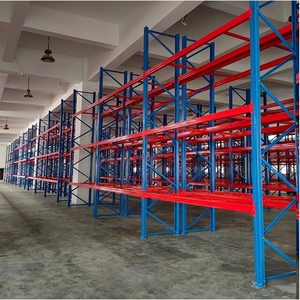
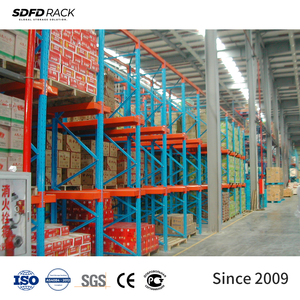
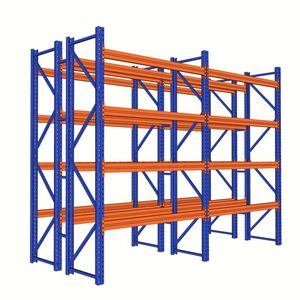
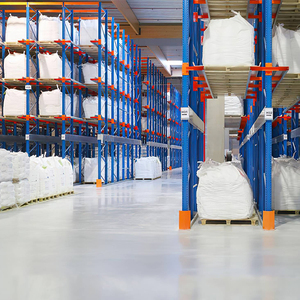
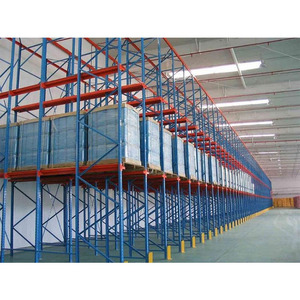
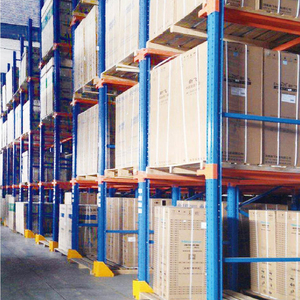
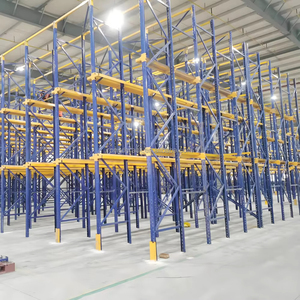
Understanding kinematic dynamics, cantilever stress, and warehouse flow is critical before selecting an anchoring topology. Operating forklifts directly within storage lanes demands strict adherence to load-path calculations and collision mitigation.
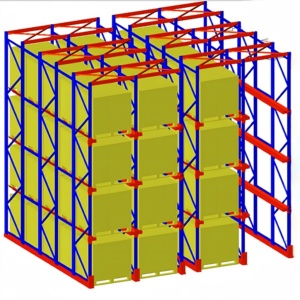
Drive-In racking utilizes a single operating aisle for loading and unloading based on First-In, Last-Out logic. Pallets are nested along continuous lateral support rails. By terminating back-to-wall or back-to-back with rigid structural cross-bracing, Drive-In frames maximize volumetric storage density for low-turnover SKUs.
Drive-Thru configurations feature dedicated entry and exit access points. Goods enter from one aisle and exit from the opposing aisle, establishing First-In, First-Out throughput. While requiring internal top tie-beams instead of rear cross-bracing, Drive-Thru systems suit perishable FMCG, pharmaceutical stock, and expiration-sensitive goods.
Because materials handling vehicles enter the interior structure, heavy floor-mounted angle-iron or structural channel guide rails (typically 100×75×8mm) are anchored to the floor slab. These rails act as steering tracks for counterbalanced or reach trucks while shielding upright columns from direct mechanical impact.
Comparative engineering parameters outlining standard configurations, structural limits, and load capacities designed for modern high-bay facilities.
| Component Specification | Standard Duty Framework | Heavy-Duty Industrial | Cold Store Refrigerated (-30°C) |
|---|---|---|---|
| Steel Grade & Yield Strength | Q235B Cold-Rolled (Yield ≥ 235 MPa) | Q355B Structural Alloy (Yield ≥ 355 MPa) | Impact Tested Structural Grade (Charpy V-Notch) |
| Upright Section Profile | 80×60mm / 90×70mm (1.8mm – 2.0mm) | 100×70mm / 120×95mm (2.0mm – 2.5mm) | 120×95mm Reinforced (2.5mm – 3.0mm) |
| Pallet Rail Profile | Formed Galvanized / Powder Coated | Heavy One-Piece Cold-Formed Arm Rail | Continuous Hot-Dip Galvanized Structural Section |
| Payload Rating per Pallet | 500 kg to 1,000 kg | 1,000 kg to 1,800 kg | Up to 2,000 kg (with dynamic impact margin) |
| Clearance Heights Max | Up to 8,000 mm | Up to 12,500 mm | Up to 14,000 mm (High-Bay Cold Facility) |
| Surface Protection System | Thermo-cured Epoxy Powder (60-80μm) | Duplex Powder Coating (80-120μm) | Hot-Dip Galvanized (ISO 1461, ≥ 70μm) |
Combining 18+ years of hands-on installation mastery, in-house technical engineering, and over 500 successfully certified industrial racking projects delivered across the GCC and global markets.
Our exclusive Project Tracking System gives procurement heads and facility managers complete, real-time visibility from CAD layout sign-off to site delivery, vertical erection, anchoring, and final safety load certification.
We do not outsource critical structural work. Our directly employed installation technicians manage mechanical torque anchoring, plumb alignment calibration, and laser-guided rail leveling to guarantee structural integrity.
Every bay calculation conforms strictly with European FEM 10.2.02, British SEMA, and American ANSI MH16.1 codes, ensuring all safety margins account for dynamic lift clearances, aisle entry impacts, and localized seismic zones.
Storage racking must not be engineered in isolation. We cross-evaluate reach-truck chassis widths, overhead guard heights, outrigger dimensions, and pallet overhangs to ensure smooth MHE transit without frame collisions.
From custom single-arm and double-arm welded cantilevers to continuous wrap-around column protectors and heavy floor-guide channels, our systems are tailored specifically to project inventory requirements.
Our commitment extends well beyond final installation. We provide certified annual structural inspections, deflection load verification, and rapid replacement of damaged upright components to guarantee operational continuity.
As warehouse operations scale globally, Drive In racking is evolving from static storage racks into hybrid, smart, and ultra-durable storage frameworks. Enterprise buyers must anticipate the following structural developments.
With global cold chain requirements accelerating across food distribution and pharmaceuticals, Drive-In systems remain the most cost-effective solution for refrigerated space. Storing maximum cubic volume within temperature-controlled areas significantly reduces thermal loss per pallet position.
Modern engineering designs now anticipate the transition toward automation. Uprights and cantilever rail brackets are engineered with modular profiles, allowing operations to upgrade static drive-in lanes into semi-automated 2D pallet shuttle channels with minimal structural modifications.
Procurement is moving rapidly away from standard carbon steel toward high-yield micro-alloyed cold-rolled steels. These materials achieve higher structural load capacities with thinner steel profiles, reducing foundation dead-loads while improving seismic performance.
Standard electrostatic finishes are increasingly replaced by high-durability duplex coatings and hot-dip galvanized components. This provides exceptional resistance to surface scraping from forklift tines and prevents corrosion in humid, coastal, and sub-zero storage environments.
Forward-thinking supply chain operators are embedding wireless strain gauge sensors and acoustic deflection monitors inside critical lane uprights. These sensors alert warehouse managers immediately when forklift collisions or load stresses exceed safety parameters.
Global corporate ESG mandates now require structural steel suppliers to provide full environmental product declarations (EPDs). Sourcing sustainably recycled steel manufactured with low carbon footprints has become a decisive criterion for enterprise tenders.
Direct technical answers to the most common questions raised by facility engineers, warehouse directors, and commercial procurement teams.
Selective pallet racking requires a dedicated operational aisle (typically 2.8m to 3.5m wide) between every back-to-back row. Drive-In racking consolidates multiple lanes into continuous structural tunnels, eliminating access aisles and increasing floor space utilization from 40% up to 80-85% for homogeneous, high-volume inventory.
Forklifts enter the racking structure directly, so vehicle width, mast collapsed height, and overhead guard clearance must be evaluated against bay clearances. Typical configurations utilize narrow-chassis reach trucks or counterbalanced forklifts fitted with protective overhead guard modifications to navigate the lane safely.
We deploy three key protective elements: heavy-gauge floor-mounted guidance tracks that physically constrain forklift lateral drift; reinforced column base protectors filled with shock-absorbing inserts; and flared lead-in guides at lane entry points to center pallet loads safely.
Because pallets rest directly on continuous lateral bracket rails rather than front-to-back load beams, consistent pallet dimensions and sound pallet construction are essential. If multiple pallet sizes (such as 1200×1000mm and 1200×800mm) must be stored, custom stepped-rail brackets or specialized pallet adapters are required.
While lanes can structurally support depths exceeding 10 to 15 pallets, best operational practice recommends lane depths between 5 and 8 pallets. Deeper lanes increase vehicle transit times and driver fatigue, while also raising the risk of operational contact with upright frames.
Drive-In racking is an industry standard for freezer facilities operating between -20°C and -30°C. By condensing goods into a consolidated thermal mass and minimizing unutilized cubic air volume, our installations significantly reduce refrigeration and energy operational costs.
Drive-In racking offers the lowest initial capital cost for high-density storage. However, if your operational throughput requires high pallet handling velocity per hour, or lane depths exceed 10 pallets, integrating semi-automated pallet shuttle carts becomes more cost-effective over a 3- to 5-year operating window.
To produce an exact structural engineering drawing and load matrix, we require your warehouse floor plan showing clear heights and column locations, slab core-drill thickness data, comprehensive pallet specifications (length, width, height, gross weight), and forklift technical cut-sheets.
Consult with our lead intralogistics structural engineers. We provide complimentary CAD spatial analysis, load-path engineering verification, and turnkey manufacturing and installation proposals tailored to your facility's operational throughput.