Direct OEM manufacturing from our certified facilities. Our production systems incorporate high-tensile structural steel, automated gravity rollers, modular decking, and ergonomic turnover equipment engineered for extreme material handling demands.
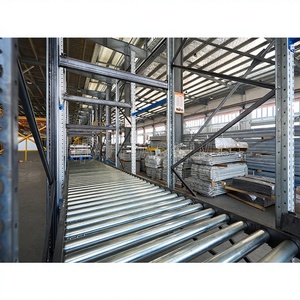
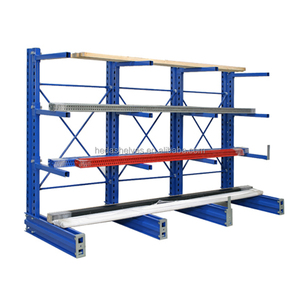
Pallet flow racking—also recognized throughout the global material handling sector as gravity flow racking—operates on an unpowered, inclined roller bed mechanism that utilizes natural gravity to slide unitized pallet loads from the loading aisle to the picking aisle seamlessly.
Precision manufacturing dictates an inclination gradient between 2.5% and 4.0% (typically 3.0° to 3.5° depending on bottom pallet board condition and total mass). China wholesale pallet flow racking factories calibrate friction coefficients using galvanized steel cylindrical rollers equipped with precision carbon steel ball bearings to ensure consistent momentum transfer without stalling or excessive velocity runaway.
For lane depths exceeding 3 pallets (and scaling up to 25 pallets deep), kinetic energy must be arrested safely. Factories integrate internal centrifugal speed controllers (magnetic or planetary gear braking rollers). These units activate automatically when pallet descent velocity exceeds 0.3 m/s, maintaining a controlled, steady descent speed of 0.15 to 0.25 m/s regardless of whether the pallet weighs 300 kg or 1,500 kg.
At the discharge face, line pressure from accumulated trailing pallets can exceed several tons, creating unsafe pallet removal conditions and dangerous forklift hang-ups. Modern factory designs incorporate mechanical time-delay or foot-actuated pallet separators. This isolates the lead pallet from trailing loads by 150–200 mm, allowing forklift tines to lift the lead unit cleanly without backpressure resistance.
Strategic warehouse architecture demands rigorous operational trade-off evaluation. China wholesale racking manufacturers deliver configurations meeting ANSI MH16.1, FEM 10.2.02, and EN 15512 structural specifications.
| Storage System Type | Space Utilization | Inventory Logic | Throughput Velocity | Forklift Travel Dist. | Power / Energy Dep. |
|---|---|---|---|---|---|
| Pallet Flow Racking (Gravity) | Very High (Up to 85%) | Strict FIFO | Extreme (Separate Aisles) | Minimized (Dedicated Faces) | Zero (Pure Gravity Kinetics) |
| Drive-In Racking | High (Up to 75%) | Strict LIFO | Low (Bottleneck Risk) | High (Deep Bay Travel) | Zero (Manual Forklift Entry) |
| Push-Back Racking | Medium-High (70%) | Strict LIFO | Moderate | Moderate (Single Loading Face) | Zero (Push Springs/Gravity) |
| Radio Shuttle Cart Racking | Extreme (Up to 90%) | FIFO or LIFO | High | Low (Automated Platform) | Battery Electric Charging |
| Selective Pallet Racking | Low (40% - 50%) | Arbitrary Access | Moderate | Maximized (Long Aisles) | Zero (Pure Static Frame) |
The procurement roadmap for enterprise distribution hubs is shifting rapidly. Supply chain executives sourcing from China wholesale factories now evaluate long-term lifecycle metrics beyond simple steel commodity spot prices.
Procurement departments are analyzing total cost of ownership (TCO) across 15-year spans. Gravity flow racking eliminates recurring battery replacement costs, motor servo servicing, software maintenance contracts, and downtime associated with motorized automated storage and retrieval systems (ASRS), delivering ROI within 18 to 26 months.
Modern flow lanes must accommodate diverse pallet types: European timber EUR-pallets (1200x800mm), American GMA 4-way pallets (48x40 in), Middle Eastern export skids (1200x1000mm), and composite plastic pallets. Factories now engineer triple-track split roller assemblies that prevent warped boards or protruding nails from seizing mid-lane.
With explosive growth in pharmaceutical logistics and flash-frozen foods, China wholesale factories are developing temperature-rated gravity systems. Uprights utilize cold-formed Q355D micro-alloyed steel tested for charpy V-notch impact resistance at -30°C, paired with synthetic low-viscosity bearing grease rated for arctic cold stores.
Chinese pallet flow racking factories have transitioned from manual metal fabrication workshops to precision automated engineering plants utilizing Industry 4.0 roll-forming and surface finishing lines.
Automated 30-station rolling mills cold-form heavy-gauge uprights (up to 3.0mm thickness) from hot-rolled structural steel coils (Q235B / Q355B) with high sectional stiffness and precision laser punching.
Beam connectors and structural load beams undergo full automated robotic dual-torch MIG welding, ensuring 100% penetration along critical shear joints to eliminate human weld inconsistency.
Automated 9-stage pre-treatment (including zinc phosphate conversion and deionized rinsing) followed by thermosetting epoxy-polyester powder coating cured at 200°C for exceptional corrosion resistance.
Tier-1 factories construct multi-lane full-scale gravity test tracks simulating actual client pallet profiles, testing brake engagement, speed variance, and separator cycling prior to container shipping.
Drawing on more than 18 years of rigorous industrial storage specialization and over 500 successfully commissioned projects worldwide, we bridge the gap between heavy structural manufacturing and flawless on-site execution.
Unlike generic wholesale trading companies, our enterprise operations feature an exclusive Project Tracking System. Clients inspect production milestones, steel quality mill certificates, punch tolerances, pre-assembly testing videos, and container loading tallies in real-time with total transparency.
Every dynamic flow rack bay is engineered in strict accordance with international standards. We perform seismic finite element analysis (FEA) based on warehouse slab load dynamics, beam deflection ratios (L/200 standard), and safety load capacity plates compliant with global warehouse labor safety norms.
From the initial warehouse clear-height laser survey to setting out, anchor drilling, frame plumbing, brake roller calibration, and certified handover inspections, our factory engineers deliver bilingual technical guidance ensuring rapid commissioning without operational disruption.
Critical engineering criteria, installation clearances, and sourcing questions addressed directly by structural storage engineers.
The engineering standard for industrial gravity flow lanes is between 2.5% and 3.5% (approx. 1:30 slope). A 3.0% slope translates to a drop of 30 mm per linear meter. Stiffer composite plastic pallets or smooth-bottom runners often operate reliably at 2.5%, whereas irregular wooden pallets with flexure or nails may require a 3.5% incline to overcome static rolling friction.
Speed controller frequency depends on pallet gross mass and total travel run. Standard engineering formulas place the initial brake roller at the second pallet position (approx. 2.4 to 2.8 meters from the infeed guide). Subsequent brake rollers are placed at intervals of every one or two pallet lengths (typically every 1.5 to 2.2 meters) to continuously reset momentum to ≤0.3 m/s.
For deep-freeze operations ranging from -15°C down to -35°C, standard commercial Q235B steel can develop cold-temperature embrittlement. Certified factories specify Q355D or Q355E high-strength low-alloy structural steel with proven sub-zero Charpy impact toughness ratings, supplemented by galvanized roller tracks and specialized low-temperature synthetic lubrication.
When pallets accumulate in deep lanes, backpressure from trailing loads compresses against the front pallet, exceeding forklift tilt capacity. Our mechanical pallet separators clamp trailing pallets 200 mm upstream. Once the forklift lifts the discharge pallet free, a mechanical linkage automatically unlocks the subsequent pallet to roll into the pick position.
To deliver precision CAD drawings and cost models, please provide: warehouse clear internal eaves height, slab compressive strength, column grid coordinates, pallet dimensional footprint (width, depth, overall height including cargo overhang), minimum/maximum unit weights, and daily turnover SKU volume.
Under normal operating conditions, gravity roller beds require quarterly visual inspection for wood debris or strapping band entanglement. Internal bearings are factory-sealed for life. Brake rollers undergo functional rotational resistance checks semi-annually, with structural upright impact safety audits conducted annually in compliance with EN 15635 guidelines.
Connect with our senior logistics application engineers today. We provide complimentary CAD warehouse layout schematics, load calculations, custom brake testing simulations, and direct factory wholesale pricing for your high-density storage project.
Contact Us