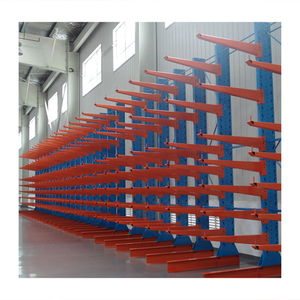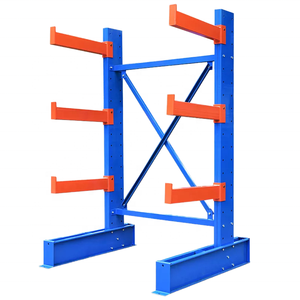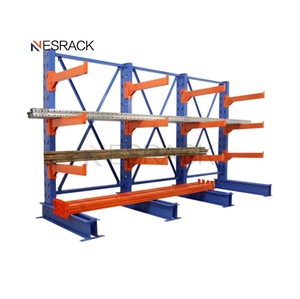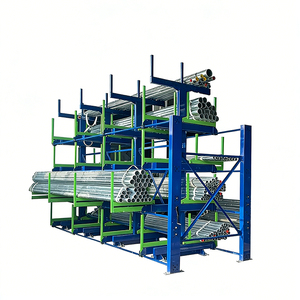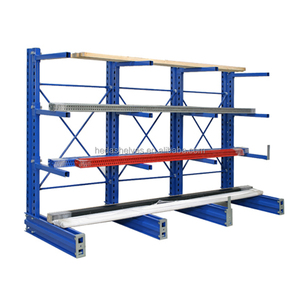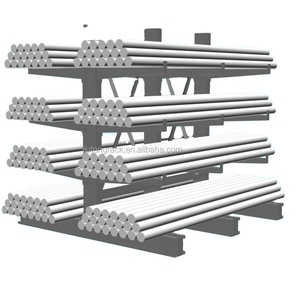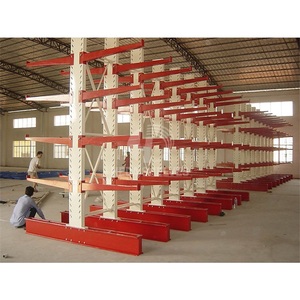
Precision-calculated static systems, hot-rolled H-section uprights, and mechanical assemblies designed for linear structural payloads, steel coils, profiles, and industrial pipes.
Cantilever racking represents one of the most mechanically demanding configurations within structural warehousing engineering. Unlike standard selective pallet racking—where horizontal loads are uniformly dispersed across front and rear upright frames with four-point beam connections—cantilever systems operate on an open-front, single-column cantilevered arm mechanism. Every stored payload induces substantial continuous bending moments ($M = F \times L$), localized shear stress, and column torsion. Without rigorous metallurgical qualification and verified structural calculations under EN 15512, EN 15620, and EN 1090-1 execution classes (EXC2/EXC3), the risk of mechanical arm deflection, base anchoring failure, and catastrophic progressive collapse multiplies significantly.
Procurement directors must distinguish between two core manufacturing typologies when sourcing heavy-duty cantilever racks:
1. Structural Hot-Rolled IPE/HEA Sections: Fabricated from solid, structural European profile steel, these profiles exhibit superior impact resistance and torsional inertia. Hot-rolled cantilevers are critical for exterior timber storage, heavy pipe yards, structural tubing, and operations where forklift contact is an unavoidable hazard. Their ductile response under extreme dynamic loading prevents sudden brittle shear failures.
2. High-Strength Cold-Formed Steel Profiles: While offering an economical weight-to-load ratio for medium-duty payloads (500kg to 1200kg per arm), cold-formed sections rely heavily on internal return lips and stiffeners. However, in heavy-duty operations (>1500kg per arm), unpredicted impact stress can induce sudden local buckling along the compressive flange of the upright, emphasizing the necessity of hot-rolled structural sections for mission-critical industrial heavy logistics.
Engineering compliance dictates that vertical arm deflection under nominal static load shall not exceed $L/200$ to $L/300$, ensuring that stored pipes or bar bundles do not slide forward. Furthermore, CE-certified cantilever arms are systematically built with a nominal upward slope of 1.5° to 2.5° to counterbalance elastic strain deflection under full rated capacity.
Strategic insights for procurement directors: how automated storage and retrieval systems (ASRS), supply chain traceability, and smart manufacturing are reshaping cantilever procurement.
The traditional reliance on counterbalance and sideloader forklifts is transitioning toward automated cantilever crane systems. Sourcing teams are increasingly specifying automated pin-point sensor brackets, optical guide paths, and tight tolerance tolerances (±1.5mm) on arm heights to facilitate robotic picking of long profiles.
Global procurement teams are shifting focus from initial purchase price to Total Cost of Ownership (TCO). High-durability hot-dip galvanized finishes (EN ISO 1461) with zinc coatings exceeding 70-85 μm are favored over thin liquid paint for outdoor setups, eliminating costly rust rehabilitation cycles over a 25-year operational lifecycle.
Future cantilever installations will incorporate embedded fiber-optic or piezoelectric strain gauges at high-moment base plates. This enables predictive overload warnings, alerting warehouse managers to unevenly placed steel stock before localized structural fatigue can propagate into base anchorage failure.
Modern manufacturing advancements that enhance load performance, mechanical ergonomics, and workplace safety.
Rigid, welded arm-to-column joints are being replaced by safety pivot pin connectors. When struck from below by an errant forklift fork, the arm pivots freely upwards without transferring disastrous bending moments into the vertical column.
Addressing the spatial limitations of narrow-aisle trucks, motorized telescopic cantilever arms extend horizontally via hydraulic or mechanical rack-and-pinion drives, allowing overhead gantry cranes 100% unimpeded vertical access.
Rack-supported outdoor building structures. The cantilever columns themselves form the primary structural support framework for roof trusses and exterior wall cladding, drastically reducing the civil engineering footprint.
Custom perforated heavy galvanized drop-in decking panels bridge the gap between cantilever arms, converting linear pipe storage instantaneously into wide-span open shelving for irregularly sized crated machinery.
Leveraging 18+ years of dedicated structural storage manufacturing, comprehensive quality assurance, and end-to-end execution.
With over 18 years of technical mastery and more than 500 major structural installations completed, our engineering design team resolves the most complex structural challenges with mathematical certainty.
From initial laser site survey and static load calculation to robotic fabrication, hot-dip galvanizing, and on-site certified installation, we maintain full accountability without third-party contracting delays.
Clients maintain complete transparency through our proprietary project tracking interface. Monitor production line phases, mill certification logs, dispatch schedules, and site installation status in real time.
Every cantilever production run is verified under rigorous quality control standards, structural welding qualifications, and full static load testing to guarantee 100% operational safety and regulatory compliance.
Critical structural, operational, and regulatory answers addressing the primary pain points of procurement officers.
Under EU Regulation 305/2011 (CPR), cantilever racks considered static structural components must comply with EN 1090-1 (Execution of steel structures). This mandates factory production control (FPC), traceable steel raw material certificates (EN 10204 3.1), qualified welding procedures (WPQR/WPS according to ISO 15614), and a legally binding Declaration of Performance (DoP).
We require: (1) Unit payload dimensions (length, depth, height), (2) Maximum and average unit weights, (3) Rigidity/flexibility of the stored goods (to calculate required spacing between arms and avoid sag), (4) Clear warehouse building height or outdoor yard parameters, and (5) Material handling equipment type (forklift model, lift height, minimum aisle clearance).
Double-sided cantilevers feature symmetrical loading on both sides of a central vertical column. When equally loaded, the bending moments on the column cancel each other out, placing the column primarily in pure axial compression. Single-sided systems impose an uncountered eccentric bending moment continuously into the base-to-foundation connection, requiring deeper base profiles and robust concrete floor anchoring.
Per European FEM and EN storage codes, cantilever arms are engineered with an upward structural incline (typically 1.5° to 2°). Under nominal safe working load (SWL), elastic strain will deflect the arm downward, but the tip will remain horizontal or slightly above the plane. Arm stops or retaining pins provide critical mechanical fail-safe security for rounded materials like pipes.
Due to intense overturning moment forces transmitted through the base plate anchors, heavy duty cantilever systems typically require reinforced concrete slabs with a minimum compressive strength of C20/25 or C25/30 and a thickness ranging from 150mm to 300mm+, verified via anchor pull-out test calculations.
Yes. Our modular engineered systems feature vertical hole pitches (typically 100mm or 140mm increments) allowing arm height reconfigurations. However, beam level adjustments alter the effective buckling length of the upright column, meaning load capacity adjustments must be re-verified by our structural engineers before moving levels.
Connect directly with our structural engineering team. Receive custom AutoCAD/BIM layout drawings, complete load-bearing calculations, and factory-direct pricing within 24 hours.
Send an Inquiry