Choosing among the 10 Best Warehouse Forklifts for Every Warehouse starts with the work, not the brochure. Warehouse Forklifts must match aisle width, load size, lift height, floor condition, and daily shift demands. A compact electric truck may suit a narrow indoor aisle. A heavier model may handle bulky pallets better, but needs room to turn. Small details matter. Tire marks near a dock can reveal rough transitions. A low beam can rule out an otherwise capable machine.
Warehouse operations consultant Maya Chen offers this practical test: “The right forklift fits the load, the route, and the people who use it every day.” That is a useful principle, not a complete buying formula. Teams should also check operator visibility, charging or refueling needs, maintenance access, and available training. Compare published capacity ratings with real loads and lift heights. Never assume a truck’s headline capacity applies in every configuration.
This guide compares common forklift types for different warehouse layouts and tasks. It considers maneuverability, power source, handling needs, and practical trade-offs. There is no perfect machine. Even a well-matched truck can disappoint when traffic patterns change or pallets vary more than expected. That deserves a second look. Use the list as a starting point, then verify requirements with qualified equipment and safety professionals. A careful site assessment can prevent an expensive mismatch. It can also make everyday moves smoother.
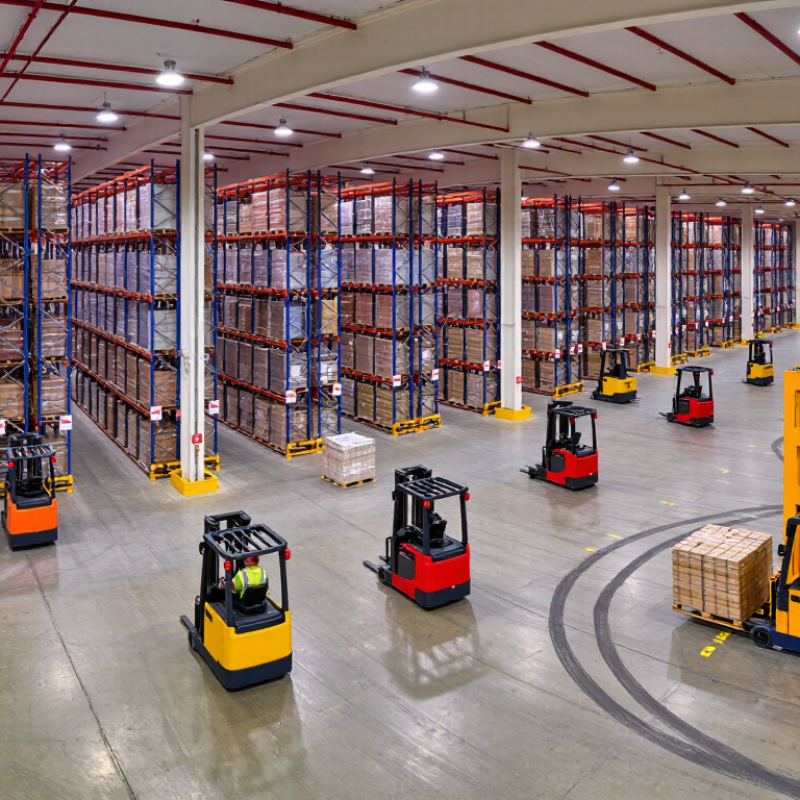
Warehouse forklifts are commonly classified by their design, because each shape suits a different material-handling task. Counterbalance trucks carry loads in front and use rear weight to stay stable. They work well at loading bays and in open aisles, but need room to turn. Reach trucks extend their forks into racks, making them useful in narrower aisles with high shelving. Order pickers lift an operator to retrieve individual items. Pallet trucks and stackers handle lower-level movement, often across short distances.
Power source is another key distinction. Battery-electric models produce no exhaust at the point of use and are often chosen for indoor work. Their runtime depends on battery capacity, charging access, and shift length. Lead-acid batteries may need dedicated charging and ventilation areas; lithium-ion batteries can support opportunity charging, but require compatible equipment and procedures. LPG and diesel forklifts can suit some outdoor or well-ventilated operations, though exhaust and noise matter indoors. Check site conditions carefully. A neat chart helps, but real aisles are rarely neat. Measure rack clearance, turning space, floor condition, and typical load weight before choosing a truck. A model that fits on paper may still feel awkward around a busy corner.
Forklift selection depends on load, aisle width, floor conditions, lift height, and duty cycle. Capacity and lift-height figures below are broad, representative ranges; actual ratings vary by configuration and load center.
| Forklift Type | Design Classification | Typical Power Source | Representative Capacity | Typical Lift Height | Best-Suited Warehouse Work | Key Consideration |
|---|---|---|---|---|---|---|
| Electric Counterbalance Forklift | Counterbalanced, sit-down or stand-up truck with front-mounted forks | Rechargeable industrial battery | About 1.0–5.0 tonnes | About 3–7 m | General pallet handling, loading docks, and indoor material movement | Produces no tailpipe emissions during operation; battery charging and changeover need planning. |
| Internal-Combustion Counterbalance Forklift | Counterbalanced truck with a rear-mounted engine and front forks | LPG, gasoline, or diesel, depending on model | About 1.5–10 tonnes or more | About 3–7 m | Outdoor yards, dock areas, and mixed indoor-outdoor work where ventilation is adequate | Engine exhaust makes indoor use subject to ventilation and site safety requirements. |
| Reach Truck | Electric stand-up truck with a retractable mast or fork carriage | Rechargeable industrial battery | About 1.0–2.5 tonnes | About 6–12 m | High-bay pallet storage in narrow warehouse aisles | Designed mainly for smooth indoor floors; confirm aisle width and rack configuration. |
| Deep-Reach Truck | Reach-truck design with forks that extend farther into deep or double-deep racking | Rechargeable industrial battery | About 1.0–2.5 tonnes | About 6–12 m | High-density storage using deep-lane pallet racks | Rack layout and pallet access strategy determine whether the extra reach is beneficial. |
| Order Picker | Elevating operator platform with forks or a load tray for piece-picking tasks | Rechargeable industrial battery | Typically about 1.0–1.5 tonnes | Platform heights commonly reach about 9–12 m | Picking individual items from elevated warehouse shelving | Operator training, fall protection, and aisle conditions are central to safe operation. |
| Electric Walkie Stacker | Pedestrian-controlled stacker with a mast and load-bearing legs | Rechargeable industrial battery | About 0.8–2.0 tonnes | About 2–5.5 m | Short-distance pallet stacking and light-to-medium warehouse duties | Usually more compact than a counterbalance truck, but needs suitable floor conditions and turning space. |
| Electric Walkie Pallet Truck | Pedestrian-controlled low-lift truck with powered travel and lift | Rechargeable industrial battery | About 1.5–3.0 tonnes | Low lift, generally sufficient to clear the floor for transport | Moving palletized goods over short distances and loading or unloading at floor level | Built for transport rather than high stacking; check pallet and ramp compatibility. |
| Rider Pallet Truck | Low-lift pallet truck operated from a standing or seated rider position | Rechargeable industrial battery | About 2.0–3.5 tonnes | Low lift, generally sufficient for pallet travel | Longer horizontal transport runs in distribution centers and large warehouses | Requires adequate travel lanes and a layout that safely accommodates a riding operator. |
| Side Loader | Side-loading truck that carries long loads alongside the chassis | Electric battery or internal-combustion engine, depending on model | About 2.0–8.0 tonnes | About 3–10 m | Long materials such as timber, pipes, and profiles stored in narrow aisles | Best suited to long loads; load dimensions and turning areas affect suitability. |
| Very-Narrow-Aisle Turret Truck | Electric high-lift truck with a rotating or articulating load-handling mechanism | Rechargeable industrial battery | About 1.0–1.5 tonnes | About 10–17 m, depending on configuration | Very high-density, high-bay storage in specially designed narrow aisles | Requires compatible racking, aisle design, and careful coordination with warehouse equipment. |
Counterbalance trucks carry front loads and use rear weight for stability. Reach trucks suit narrow aisles and tall racks. Order pickers lift operators to individual items. Pallet trucks and stackers handle short, low-level moves.
Reach trucks often fit narrow aisles and high shelving. Measure clear width and turning space first. A chart may miss an awkward corner.
Check aisle width, door openings, rack height, turning space, floor condition, and typical load dimensions. Measure the actual space, not just drawings.
Capacity can decrease when loads are raised high or carried on long attachments. Check the capacity plate for the exact setup. Don’t guess.
Battery-electric forklifts produce no exhaust at the point of use. Runtime depends on battery capacity, charging access, and shift length. Noise still matters.
They may suit outdoor or well-ventilated operations. Exhaust and noise can be concerns indoors. Check site conditions carefully.
Smooth concrete may suit electric equipment. Uneven dock plates, ramps, congestion, and blind corners may require different tires or drive capability. Watch a real shift.
A trial with representative loads can reveal tight turns, poor sightlines, or awkward handling. The fastest truck may not fit best. One corner is easy to overlook.
Choosing the right Warehouse Forklifts begins with understanding how models differ by design and power source. This guide explains common types and the features that matter when comparing them, including lifting capacity, maneuverability, operating time, and suitability for indoor work. It also outlines ten leading forklift options, highlighting the distinct capabilities that can help warehouses handle different materials and tasks.
A forklift’s ideal fit depends on the facility’s layout, aisle width, storage height, floor conditions, and workload. The guide considers how these factors shape equipment selection, along with the importance of safety features, operator training, routine inspections, and maintenance. By weighing performance against the demands of a specific workplace, warehouse managers can make a more informed choice that supports efficient, dependable material handling.